How to Choose a Bicycle Brake Pad Manufacturer for OEM Projects
For bicycle brands, component brands, importers, and distributors, choosing a bicycle brake pad manufacturer should not come down to unit price alone.
A bicycle brake pad is a small component, but in use it directly affects braking power, brake noise, wear life, initial bite, and performance across different temperatures and in dry and wet conditions.
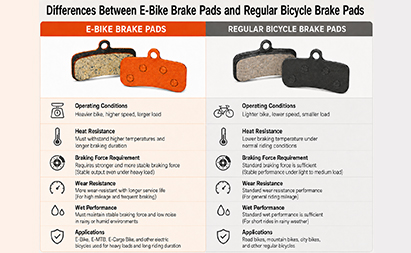
This is especially true for e-bikes, mountain bikes, cargo bikes, and enduro and downhill bikes. Because vehicle weight, speed, payload, and the loads generated by repeated braking all differ, the demands placed on the brake pad differ as well.
For an OEM project, the right manufacturer needs to do more than supply the correct pad shape. It should also be capable of friction material formulation development, performance testing, sample validation, and consistent mass production. The points below are what bicycle brands and sourcing teams should check first when evaluating a bicycle brake pad manufacturer for OEM supply.
Key Takeaways
- Beyond price and pad shape, confirm that the manufacturer is capable of friction material formulation development, performance testing, sample validation, and consistent mass production.
- ADUI currently offers approximately 70 bicycle brake pad shapes and approximately 10 bicycle-specific friction material formulations.
- OEM development should start from actual performance requirements, with priorities agreed first rather than expecting every property to reach its maximum at once.
- When a customer supplies an existing product or a competitor sample, it can be performance tested first and used as a reference baseline for formulation selection.
- Bicycle brake pad performance testing mainly uses relevant ISO 4210 test requirements as a reference, with a focus on batch consistency in mass production.
1. Does the Manufacturer Offer Enough Brake Pad Shapes?
The first thing to confirm in an OEM project is usually whether the brake pad shape fits the existing brake system.
Different brands, calipers, and brake system generations may all use different pad shapes. The range of shapes a manufacturer has already built up therefore has a direct effect on how quickly a new project can be reviewed and developed.
ADUI can carry out an initial compatibility check based on the following information from the customer:
- Existing brake pad sample
- Brake pad shape
- Product drawing
- Caliper model
- Existing product part number
Note: Even within a single brand, several different pad shapes may exist. A brand name alone is not enough for an OEM project; providing the full caliper model or a physical sample reduces the risk of a shape mismatch and speeds up the initial review.
2. Does It Have Multiple Bicycle-Specific Friction Compounds?
Broad categories such as organic, semi-metallic, or sintered are not enough to judge whether a bicycle brake pad suits a given application. Real OEM development should start from the actual performance requirements.
These formulations can be selected according to the application and the performance required. Different projects may prioritize:
- Braking Power
- Noise Control
- Service Life
- High-Temperature Stability
- Wet Performance
- Initial Bite
A low-noise compound that works well for city commuting may not suit long descents or heavily loaded e-bikes. Likewise, a material focused on higher braking power will not necessarily deliver the lowest noise or the longest service life.
The key to OEM development is therefore not choosing a material by name, but first defining the most important performance target for the product. The manufacturer should then select a suitable friction compound based on actual operating conditions, the target market, and the customer's requirements.
3. Can Performance Be Tuned to Your Requirements?
Braking requirements differ between markets and bike categories. A manufacturer with its own friction material development capability should therefore be able to select materials or adjust formulations to suit each project.
ADUI can currently discuss the following performance areas according to customer requirements:
- Braking Performance
- Initial Bite
- Brake Noise
- Wear Life
- High-Temperature Stability
- Wet Performance
These properties are not fully independent. Increasing braking power, for example, may also affect wear, noise, or rotor behavior. Well-run OEM development usually starts by agreeing on performance priorities rather than expecting every property to reach its maximum at the same time.
4. Will the Manufacturer Benchmark Your Existing Product First?
If the customer already has an existing product or a competitor sample, comparing against the actual part is usually more efficient than describing requirements in words alone.
In a new project, when the customer supplies an existing brake pad, ADUI first runs performance testing to understand how the current product actually performs, then uses the results as a reference baseline for formulation selection or development.
This performance benchmarking approach is particularly useful when:
- The existing product wears out too quickly
- Brake noise occurs easily in use
- Braking performance is insufficient
- The customer is looking for an alternative supplier
- The customer wants to keep certain characteristics while improving others
For example, if the braking performance of the customer's product already meets requirements but service life is too short, the development direction should not simply be to raise friction. The goal is to improve wear life while keeping the original braking behavior as far as possible.
Using an existing sample as the benchmark makes the development direction far more specific.
5. Does It Understand How Requirements Differ by Application?
Even with the same brake pad shape, operating conditions can differ completely from one bike category to another.
| Application | Key Requirements |
|---|---|
| City / Urban Bikes | Low noise, consistent braking, durability |
| Road Bikes | Linear modulation, low noise, predictable control |
| Gravel Bikes | Performance in both dry and wet conditions; dust, mud, and grit |
| Mountain Bikes | Braking power, wear resistance, wet performance |
| Enduro / Downhill | High-temperature stability, fade resistance, repeated braking |
| E-Bikes / E-MTB | Higher loads, wear resistance, high-temperature stability |
| Cargo Bikes | High payload, frequent braking, long service life |
At the start of an OEM project, the manufacturer should first understand:
- Which type of bicycle the pad will be used on
- Vehicle weight and load conditions
- Whether the riding environment is urban, mountainous, or involves long descents
- The issue the customer most wants to improve
- Which performance property matters most
This information is usually far more valuable for development than simply asking which material type is required.
6. Is There a Clear Performance Testing Standard?
Beyond dimensions and shape, an OEM project also needs to verify actual braking performance.
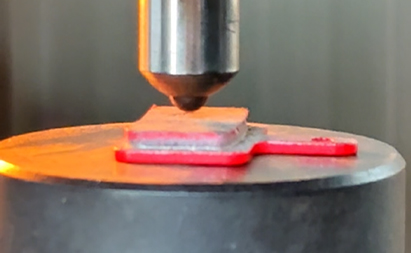
ADUI currently uses relevant ISO 4210 test requirements as a reference for bicycle brake pad performance testing.
For bicycle brake pads, the purpose of testing is not only to confirm that sufficient braking force can be generated. More importantly, it shows whether the product maintains consistent braking under different conditions.
When a customer needs to compare different formulations or samples, fixed test conditions make the differences between products much easier to assess.
During OEM development, test results can typically be compared against:
- Customer's Existing Product
- Competitor Sample
- Existing ADUI Formulation
- Newly Developed Sample
The test results then determine the next step in material direction.
7. Is There a Complete OEM Development Process?
ADUI's OEM development process for bicycle brake pads generally follows these steps:
- Customer Sample
- Performance Testing
- Friction Material Selection
- Sample Production
- Customer Validation
- Adjustment
- Pilot / Small-Batch Production
- Mass Production
8. How Are the Most Common OEM Customer Issues Handled?
Short Service Life / Excessive Wear
When a customer reports that pads wear too quickly, the first step is usually not to switch straight to a harder material.
The bike category, operating environment, original braking performance, temperature conditions, and the performance of the customer's original sample need to be understood first. Suitable formulations can then be selected for comparison.
Wear life cannot be improved in isolation; it is also necessary to confirm whether the change affects braking performance or other properties.
Brake Noise
Disc brake noise is one of the most common issues in the bicycle market.
Noise can be related to the friction material, rotor condition, humidity, temperature, brake pressure, and system vibration, so the material cannot be assessed on its own.
If review confirms that the friction material is the main factor, different material directions can be compared to improve the result.
Insufficient Braking Performance
When a customer feels braking performance is insufficient, the actual problem needs to be identified first, for example:
- Weak initial bite
- Insufficient maximum braking power
- Performance drop at high temperature
- Insufficient wet performance
The material solution is not the same in each case, so it is best to define the problem precisely before deciding how to adjust the friction material.
9. Why Does Production Consistency Matter?
What OEM customers really need is more than a single sample that performs well. What matters more is whether every batch performs consistently once mass production begins.
A friction material is made from many raw materials, so all of the following factors can affect the final product:
- Raw Materials
- Mixing
- Hot Press Molding
- Temperature
- Pressure
- Post-Processing
- Grinding
For a brand, excessive batch-to-batch variation in braking performance, noise, or wear leads directly to complaints from the market.
For this reason, ADUI focuses in OEM projects not only on peak performance in a single test, but on consistent mass-production quality and batch consistency.
10. ADUI's Three Core Strengths
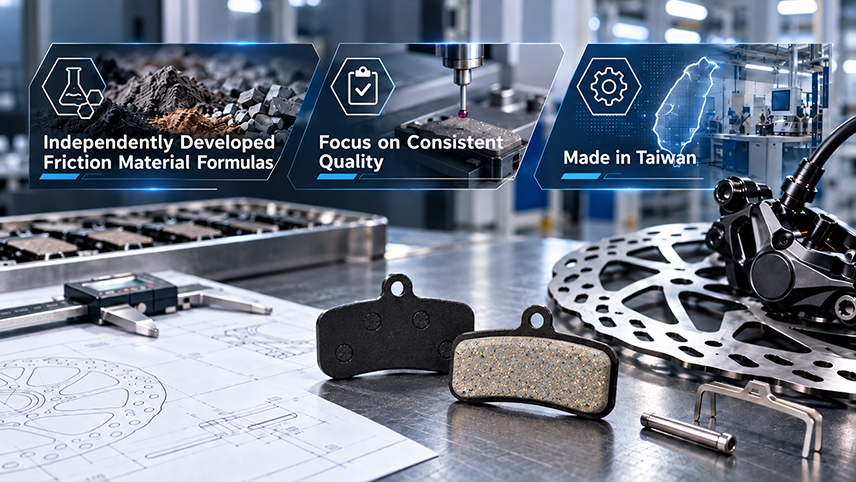
In-House Friction Material Development
ADUI has its own friction material development capability and currently offers approximately 10 bicycle-specific friction material formulations, which can be selected and adjusted according to the application and performance requirements.
Focus on Consistent Quality
In OEM projects, ADUI looks beyond sample performance to whether product performance can be maintained in subsequent mass production.
From material selection and sample testing to small-batch and mass production, product performance is checked against expectations at every stage.
Made in Taiwan
ADUI is a brake pad manufacturer based in Taiwan. From product development and material selection to performance testing and mass production, its focus is on long-term cooperation with business customers.
Approximately 70 bicycle brake pad shapes are currently available, supporting a range of bicycle brake systems and application markets.
11. What Information Should You Provide Before an OEM Project Starts?
Before a project starts, we recommend providing as much of the following information as possible to support the initial review:
- Brake Pad Shape
- Physical Sample
- Product Drawing
- Caliper Brand and Model
- Bicycle Application
- Existing Product Information
- Target Performance
- Current Issues
Examples of How to Describe Your Requirements
- "Our current pads wear out too quickly, but we want to keep the same braking performance."
- "Braking performance is currently insufficient, and we would like a stronger initial bite."
- "We get brake noise in the rain and want to reduce noise in wet conditions."
12. Conclusion
When choosing a bicycle brake pad manufacturer for an OEM project, price and pad shape should not be the only checks. It is more important to confirm that the manufacturer has:
- A sufficient range of brake pad shapes
- Multiple bicycle-specific friction compounds
- Friction material development capability
- The ability to benchmark existing products
- Bicycle brake performance testing capability
- A clear sample development process
- The ability to resolve noise, wear life, and braking performance issues
- Consistent mass-production quality
For a brand, a manufacturer suited to long-term cooperation should go beyond supplying product and help resolve performance issues.
ADUI currently offers approximately 70 bicycle brake pad shapes and approximately 10 bicycle-specific friction material formulations, and can support OEM and joint development projects based on targets such as braking performance, brake noise, wear life, high-temperature stability, wet performance, and initial bite.
If you already have an existing brake pad or a competitor sample, you can also provide it for performance benchmarking, and a suitable friction material direction can then be assessed from the test results.
Frequently Asked Questions
What matters most when choosing a bicycle brake pad manufacturer for an OEM project?
Price and pad shape are only part of the picture. It is more important to confirm that the manufacturer offers a sufficient range of brake pad shapes, multiple bicycle-specific friction compounds, in-house friction material development, performance testing capability, a clear sample development process, and consistent quality in mass production.
Can an evaluation start if we only have a sample of our existing brake pad?
Yes. When a customer supplies an existing brake pad, ADUI first runs performance testing to understand how the current product actually performs, then uses the results as a reference baseline for formulation selection or development. Providing the caliper model, the application, and the target performance at the same time makes the initial review more efficient.
Can one friction compound be used for every type of bicycle?
Not necessarily. A low-noise compound that works well for city commuting may not suit long descents or heavily loaded e-bikes. The manufacturer should select the friction compound based on actual operating conditions, the target market, and the customer's requirements.
Can we ask for improvements in brake noise or wear life?
Yes. ADUI can discuss braking performance, initial bite, brake noise, wear life, high-temperature stability, and wet performance according to the customer's needs. Because these properties influence one another, we recommend agreeing on performance priorities first and then deciding on the material direction.
Why is production consistency more important than the performance of a single sample?
If braking performance, noise, or wear varies too much from batch to batch, the result is complaints from the market. For this reason, an OEM project should focus not only on peak performance in a single test, but on consistent mass-production quality and batch-to-batch consistency.
How many bicycle brake pad shapes and bicycle-specific compounds does ADUI currently offer?
ADUI currently offers approximately 70 bicycle brake pad shapes and approximately 10 bicycle-specific friction material formulations, which can be selected and adjusted according to the application and performance requirements.

![[R&D Insights] No More Screeching in Rainy Road Cycling: NVH-Driven Silent Brake Pad Development](/upload-files/faq/nvh-driven-silent-brake-pad-innovation/nvh-driven-silent-brake-pad-innovation.jpg "[R&D Insights] No More Screeching in Rainy Road Cycling: NVH-Driven Silent Brake Pad Development")