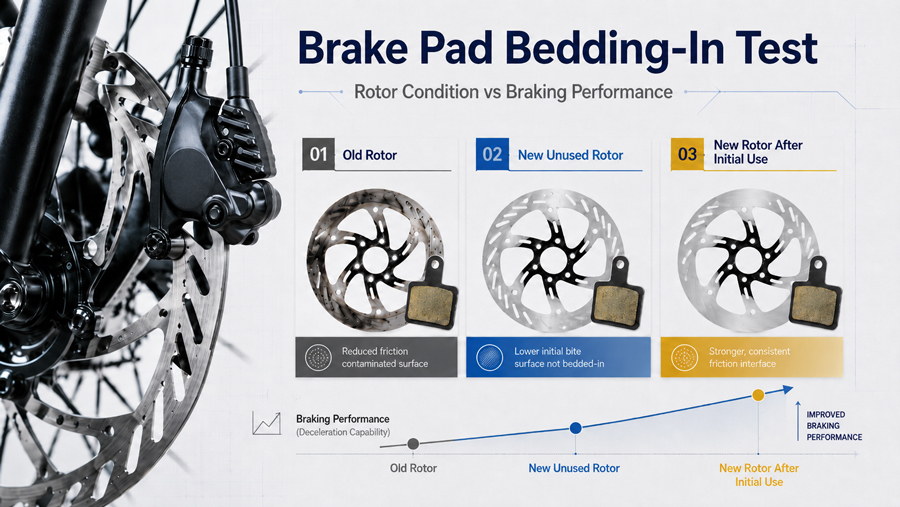
Brake Pad Bedding-In Test Rotor Condition vs Braking Performance

Back
ADUI BRAKE · Disc Brake Bedding-In Guide

How to Bed-In Bike Disc Brakes:
Why New Pads Feel Weak or Squeal

A practical guide and dry braking test explaining why new bicycle brake pads feel weak or squeal — with rotor condition data across 20 N to 160 N handle force.

Category Brake Pad Testing · Disc Brake
Application E-Bike · Cargo Bike · MTB · Urban
Author ADUI BRAKE INDUSTRY INC.
Bike Disc Brake Bedding-In · New Brake Pads Feel Weak · Brake Squeal Causes

When riders install new bicycle brake pads, two common complaints appear: weak braking power and brake squeal. This guide explains why both happen, uses dry braking test data to show how rotor condition affects performance, and provides a step-by-step bedding-in process to resolve the problem.

Bedding-In Process Dry Braking Test Data Transfer Layer E-Bike Brake Pads Rotor Condition
+34%
Deceleration Gain @ 100N

New rotor after one initial use vs. old rotor at 100 N handle force.

+21%
Deceleration Gain @ 160N

New rotor after one initial use vs. old rotor at maximum test handle force.

3
Rotor Conditions Tested

Old rotor, new unused rotor, and new rotor after one initial use.

10–20x
Bedding-In Cycles

Recommended number of controlled braking cycles for initial bedding-in.

Overview

What Is Brake Pad Bedding-In?

Brake pad bedding-in — also known as disc brake break-in — is the process of creating a stable contact condition between the bicycle brake pad and the disc brake rotor. The goal is not simply to wear the surface. More importantly, it helps the pad material and rotor surface form a consistent friction interface.

Bedding-In Test Conditions
Brake Type Front Brake
Speed 12.50 Km/hr
Cycle Stop Time 3.00 sec
Number of Stops 20 times
Braking Time 3.00 sec
Stop Time 3.00 sec
Load 100.00 kgf
01

Surface High Points Are Leveled

Microscopic peaks on both the brake pad and rotor are gradually worn down, increasing the true contact area and improving friction efficiency.

02

A Transfer Layer Forms on the Rotor

A thin, even layer of friction material deposits onto the rotor surface. This transfer layer creates a more consistent friction interface between pad and rotor.

03

Friction Coefficient Stabilizes

As the interface matures, braking force becomes more predictable. Modulation improves, and noise and vibration are reduced when the process is done correctly.

04

Without Proper Bedding-In

Riders may experience weak initial braking, unstable brake feel, longer stopping distance, or brake noise — none of which necessarily mean the pad is defective.

Lab Test Data

Dry Braking Test: Rotor Condition vs. Deceleration

Dry Braking Test Conditions
Brake Type Front Brake
Speed 12.50 Km/hr
Cycle Stop Time 3.00 sec
Number of Stops 5 times
Braking Time 3.00 sec
Stop Time 3.00 sec
Load 100.00 kgf

The following test measures braking deceleration at handle forces from 20 N to 160 N across three rotor conditions. The highlighted range (40 N – 100 N) represents the most practical braking force levels in everyday riding and clearly shows how rotor condition affects braking power.

Highlighted: Practical braking range (40 N – 100 N)
Best performance (Sample 3)
Sample Rotor Condition 20 N 40 N 60 N 80 N 100 N 120 N 140 N 160 N
Deceleration (m/s²) ▲ Practical Braking Range
Sample 1 Old rotor 0.56 1.28 2.20 2.81 3.49 4.13 4.64 4.85
Sample 2 New unused rotor 0.58 1.50 2.55 3.29 3.96 4.35 4.66 5.00
Sample 3 New rotor — after one initial use 0.79 1.82 2.99 3.94 4.68 5.18 5.54 5.86

Unit: deceleration m/s² · Test method: dry braking · Handle force range: 20 N – 160 N

Key Finding

Bedding-In Improves Braking Power

The test data shows a clear ranking across all handle force levels. The new rotor after one initial use consistently delivered the highest deceleration values.

Sample 1
Old Rotor
@ 100 N 3.49 m/s²
@ 160 N 4.85 m/s²
Baseline reference — lowest deceleration across all levels
Sample 2
New Unused Rotor
@ 100 N 3.96 m/s²
@ 160 N 5.00 m/s²
Slightly better than old rotor, but transfer layer not yet formed
Sample 3 · Best Performance · Best Performance
New Rotor After One Initial Use
@ 100 N 4.68 m/s²
@ 160 N 5.86 m/s²
+34% vs Sample 1 @ 100 N  ·  +21% vs Sample 1 @ 160 N

This result confirms that a properly conditioned rotor surface — through initial bedding-in — can significantly improve both braking force and braking stability. An old rotor with surface degradation or contamination may actually underperform a new rotor that has completed only one initial use cycle.

Technical Analysis

Why Does a New Rotor Sometimes Feel Weak at First?

A new rotor may look clean and smooth, but its surface is not yet optimized for braking. Three technical factors explain why initial braking power can be lower than expected.

01

Contact Area Not Fully Developed

Even when a brake pad and rotor look flat, their surfaces are not perfectly matched at a microscopic level. Initially, only a small portion of the pad contacts the rotor effectively, reducing friction efficiency. After several controlled braking cycles, contact area expands and braking power increases.

02

Transfer Layer Has Not Formed Yet

A stable transfer layer — a thin deposit of pad material on the rotor surface — is one of the most important factors in disc brake performance. Without it, riders may notice weak braking, unstable response, longer stopping distance, noise, poor modulation, or sudden changes in brake feel.

03

Old Rotor Surface Degradation

An old rotor may already carry a transfer layer, but it can also contain uneven wear, oxidation, old pad residue, heat spots, surface grooves, or contamination. These factors reduce the effectiveness of a new brake pad — which is why the old rotor showed the lowest deceleration in this test.

Application Focus

Why Bedding-In Is Critical for E-Bikes and Cargo Bikes

E-bikes and cargo bikes place significantly higher loads on the braking system than standard bicycles. For these applications, bedding-in is not a small detail — it directly affects safety, durability, and rider confidence.

Load Factor
Higher Vehicle Weight

Battery, motor, and cargo add significant mass, increasing braking inertia and thermal load per stop.

Frequency Factor
More Frequent Braking

Urban delivery and commuting cycles involve repeated stop-start braking that accelerates wear and raises operating temperature.

Thermal Factor
Higher Braking Temperature

Long downhill sections and heavy loads generate sustained heat. A properly bedded pad handles thermal cycles more consistently.

Safety Factor
Stable Brake Control Required

E-bike and cargo bike riders depend on consistent modulation for safety. Bedded pads provide more predictable braking response.

Practical Guide

How to Properly Bed-In Bicycle Brake Pads and Rotors

A simple, controlled bedding-in process can significantly improve brake performance from day one. Avoid extreme braking during the first few stops — overheating the pad surface too early may cause uneven material transfer or glazing.

Bedding-In Test Conditions
Brake Type Front Brake
Speed 12.50 Km/hr
Cycle Stop Time 3.00 sec
Number of Stops 20 times
Braking Time 3.00 sec
Stop Time 3.00 sec
Load 100.00 kgf
01

Ride in a safe, open area with enough space to brake and roll to a complete stop.

02

Accelerate to a moderate speed (approximately 20–30 km/h for most applications).

03

Apply the brake with medium, controlled force. Slow the bike down without fully locking the wheel.

04

Repeat the braking cycle 10 to 20 times. Allow short rolling intervals between each stop to avoid excessive heat buildup.

05

Do not hold the brake when the rotor is hot. Release fully after each braking cycle.

06

Allow the brake system to cool completely after the bedding-in session before riding in demanding conditions.

Diagnosis

Common Symptoms Before Proper Bedding-In

Braking force feels weak or inconsistent
Longer stopping distance than expected
Brake lever feel is inconsistent
Brake noise appears during braking
Pad surface appears shiny or glazed
Braking power changes after several stops

These symptoms do not always mean the brake pad is defective. In many cases, the system simply needs a correct bedding-in process.

Conclusion

Rotor Condition Matters More Than Most Riders Think

This dry braking test confirms three key results:

The old rotor had the lowest braking performance across all handle force levels.

The new unused rotor performed slightly better — but the transfer layer had not yet formed.

The new rotor after one initial use showed the highest braking force — up to 34% improvement at 100 N.

For bicycle brands, brake pad suppliers, and e-bike manufacturers, bedding-in test data helps explain product performance clearly and reduces misunderstanding during product evaluation.

FAQ

Frequently Asked Questions

Q. Why do new bike brake pads feel weak at first?
A.

New bike brake pads may feel weak because the brake pad and rotor surfaces have not fully matched yet. The transfer layer has not formed, and the real contact area is still limited. A proper bedding-in process resolves this by building a stable friction interface between pad and rotor.

Q. Do new bicycle rotors need bedding-in?
A.

Yes. New bicycle rotors should be bedded in with the brake pads to create a stable friction surface. As this test data shows, a new rotor after one initial use significantly outperforms a new unused rotor — confirming that the bedding-in process makes a measurable difference.

Q. How long does it take to bed in bicycle brake pads?
A.

In most cases, 10 to 20 controlled braking cycles are sufficient for initial bedding-in. However, the exact result depends on brake pad material, rotor condition, rider weight, speed, and braking temperature. For e-bikes and cargo bikes with higher thermal loads, a more gradual process may be beneficial.

Q. Can an old rotor reduce braking performance?
A.

Yes. This test confirms it. An old rotor may carry uneven wear, oxidation, old brake pad material, heat spots, surface grooves, or contamination — all of which reduce the effectiveness of a new brake pad. In this dry braking test, the old rotor produced the lowest deceleration values across all handle force levels.

Q. Why is bedding-in important for e-bike brake pads?
A.

E-bikes are heavier and generate significantly higher braking loads than standard bicycles. Proper bedding-in helps the brake pad and rotor build a stable friction interface that can handle the thermal and mechanical demands of e-bike use — improving braking force, heat stability, brake feel, and overall safety.

OEM · ODM · Custom Development

Need Custom Bicycle Brake Pads for
E-Bike, Cargo Bike, or MTB Applications?

We develop and manufacture bicycle brake pads for different riding conditions, including e-bike, cargo bike, mountain bike, and urban commuting applications. Our friction material development focuses on braking power, noise control, wear resistance, heat stability, and rotor compatibility.

If you are looking for an OEM or ODM bicycle brake pad manufacturer, contact us to discuss your testing requirements, material direction, and product development goals.

ADUI BRAKE INDUSTRY INC.  ·  New Taipei City, Taiwan  ·  [email protected]

0 Top