Top 10 E-Bike
Brake Pad FAQs
E-Bikes are heavier, faster, and used more intensively than standard bicycles — placing far greater demands on brake pads. This guide covers the top 10 practical FAQs, from compound selection and wear causes to noise diagnosis and replacement timing, helping fleet managers and buyers make safer, more efficient decisions.
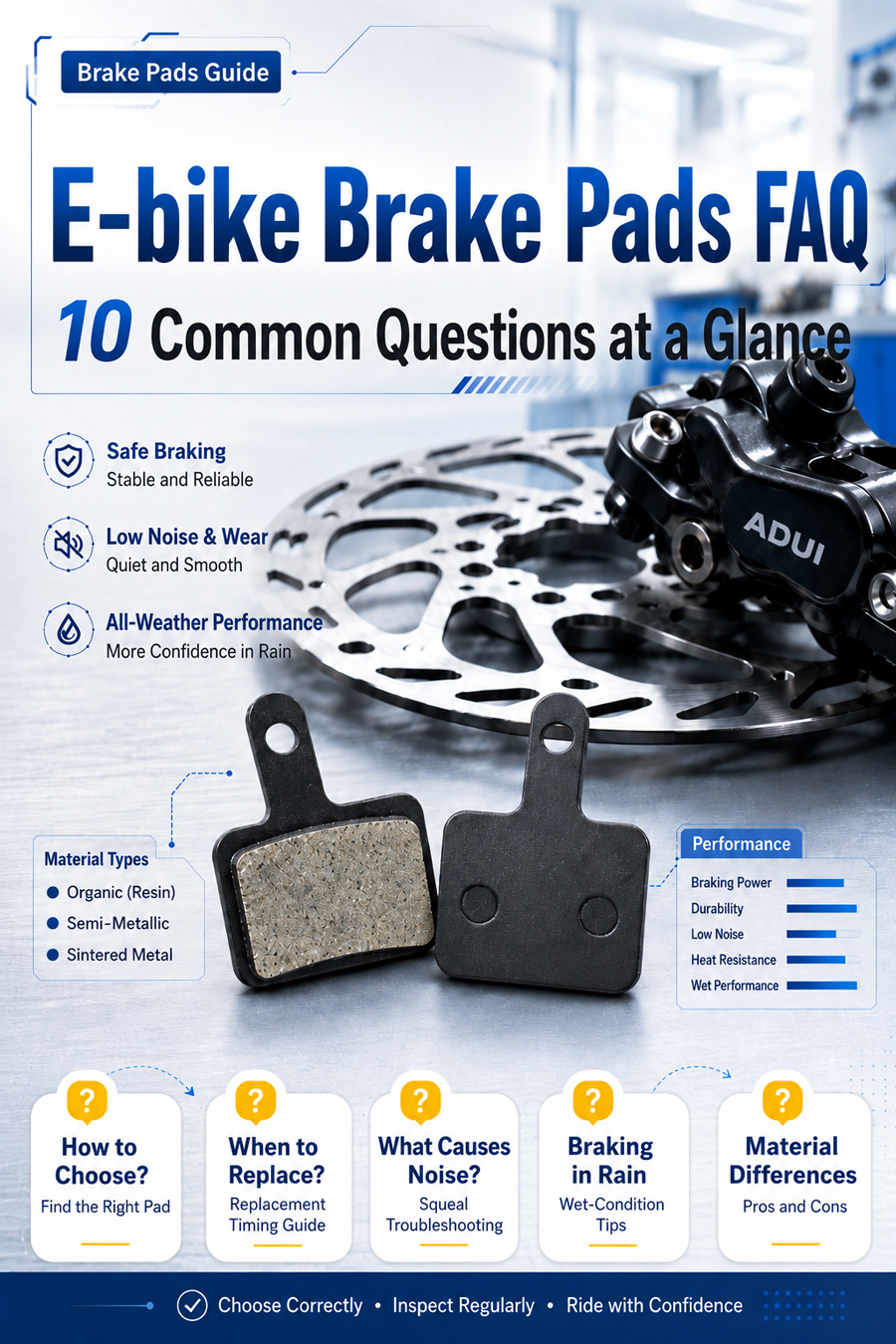
Resin, Semi-Metallic, and Sintered — each suited to different operating conditions.
Weight, speed, frequency, environment, and wrong compound — any factor can shorten service life.
From pad thickness and stopping distance to abnormal noise — any sign means inspect immediately.
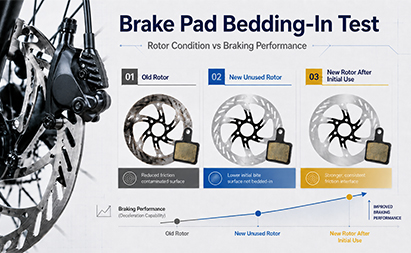
New pads require proper break-in to achieve optimal braking stability and minimize noise.
Q1–Q4 · Which Brake Pad Compound Is Right for Your E-Bike?
Compound choice directly affects braking power, heat resistance, rotor wear, and noise. There is no universally best compound — only the right one for your application.
How are E-Bike brake pads different from standard bicycle brake pads?
E-Bikes are typically heavier and faster, generating higher heat loads during braking. This demands better heat resistance, wear durability, and braking stability. Standard pads used in E-MTB, cargo bike, or long-descent conditions may wear out faster, lose braking power, or generate more noise.
Are resin brake pads suitable for E-Bikes?
Yes, but mainly for general commuter E-Bikes or low-noise applications. Resin pads are quiet, offer smooth feel, and are rotor-friendly. However, under high heat, long descents, or heavy load, their wear resistance and heat fade performance is typically inferior to semi-metallic or metallic compounds.
Are semi-metallic brake pads suitable for E-Bikes?
Semi-metallic pads are among the most common choices for E-Bikes, balancing braking power, wear resistance, heat tolerance, and cost. For E-MTB, cargo bikes, or higher-load E-Bikes, semi-metallic compounds are generally more suitable than standard resin pads.
Are sintered metal brake pads the best choice for E-Bikes?
Not necessarily. Sintered metal pads excel in high-load, high-heat, long-descent, and wet/muddy conditions, but may generate more noise and increase rotor wear. For quiet, comfortable urban commuting, sintered pads may not be the optimal choice.
Q5 · How Do You Choose the Right E-Bike Brake Pad Compound?
Match your compound to actual operating conditions — no single compound fits every application.
Q6 · Why Do E-Bike Brake Pads Wear Out Faster?
E-Bike brake pads wear faster for multiple reasons — any single factor can shorten service life. If pads wear out noticeably faster than expected, also check rotor condition, caliper alignment, and whether the compound is appropriate for E-Bike use.
Higher Vehicle Weight
The combined weight of battery and motor significantly increases inertia during braking, placing far greater load on pads per stop than standard bicycles.
Higher Riding Speed
Higher speed means greater kinetic energy during braking, converting to more heat and accelerating friction material wear.
Higher Braking Frequency
Logistics cargo bikes or urban commuters with frequent stop-start cycles accumulate far more braking events than standard bicycles.
Frequent Long Descents or Loaded Riding
Continuous braking keeps pads at sustained high temperatures, increasing heat fade risk and placing much greater demands on friction material durability.
Using a Compound Not Suited for E-Bikes
Standard commuter-spec resin pads can have significantly reduced service life under high-load E-Bike conditions.
Rough or Worn Rotor Surface
Damaged or deeply grooved rotor surfaces accelerate friction material consumption — rotor condition must be evaluated alongside pad condition.
Wet, Sandy, or Dusty Riding Environments
Foreign particles entering the braking interface create an abrasive effect, significantly accelerating wear on both pads and rotors.
Q7 · Is Brake Noise Normal on E-Bikes?
Slight braking noise is sometimes normal — particularly in wet conditions, on a cold bike, after long descents, or with higher-metallic compounds. However, persistent abnormal noise usually indicates an issue that needs attention.
Slight noise in wet or cold-start conditions, brief noise after long descents, minor sound from higher-metallic compounds, and noise during new pad break-in are all within normal acceptable range.
If noise persists, clean the rotor surface, re-check caliper alignment, and confirm the pad model is appropriate for the bike and rotor material.
Q8 · When Should You Replace E-Bike Brake Pads?
Due to higher weight and braking loads, E-Bike brake pads and rotors should be inspected more frequently than standard bicycles. Replace immediately when any of the following conditions occur.
Friction material too thin At or below minimum safe thickness — replace immediately
Noticeable loss of braking power Lever requires more force to achieve effective braking
Increased stopping distance Longer distance required to stop from the same speed
Metallic scraping or sharp noise Persistent noise occurring during braking
Surface scorched, hardened, or glazed Pad has exceeded its thermal limit
Oil or grease contamination Braking performance does not recover after cleaning
Significantly uneven wear between left and right pads May indicate caliper or rotor issues requiring inspection
Persistent poor feel after long descents Instability remains after recovery — do not continue use
Q9–Q10 · New Pad Break-In and Self-Installation
Correct installation and break-in are the final steps to ensure brake pads perform at their best — they cannot be skipped.
Do new E-Bike brake pads need to be broken in?
Yes. New pads and rotors have not yet fully mated, so braking performance may not reach its optimal state immediately after installation. Proper break-in allows friction material to transfer evenly onto the rotor surface, improving braking stability and reducing the risk of noise.
Perform multiple moderate-speed stops on a safe road. Avoid heavy braking or long descents during the break-in period. Once complete, braking feel is typically more consistent and stable.
Can I replace E-Bike brake pads myself?
Yes, but you must verify installation orientation, caliper position, and rotor condition. Pay attention to the following points:
If you are unfamiliar with brake systems, have the pads replaced by a bike shop or qualified technician to avoid installation errors that could compromise braking performance.
Choosing the Right Brake Pad Is the First Step to E-Bike Safety
E-Bike weight, speed, and operating intensity make brake pad selection and maintenance far more critical than on standard bicycles. Understanding each compound's application, diagnosing wear and noise correctly, and replacing at the right time — these three things together keep an E-Bike's braking system reliable under any conditions.
For compound selection advice specific to your bike model or fleet, contact the ADUI sales team directly.
Contact ADUI Sales Team
For E-Bike brake pad selection advice, technical specifications, or OEM / ODM pricing, contact ADUI BRAKE INDUSTRY INC. directly.